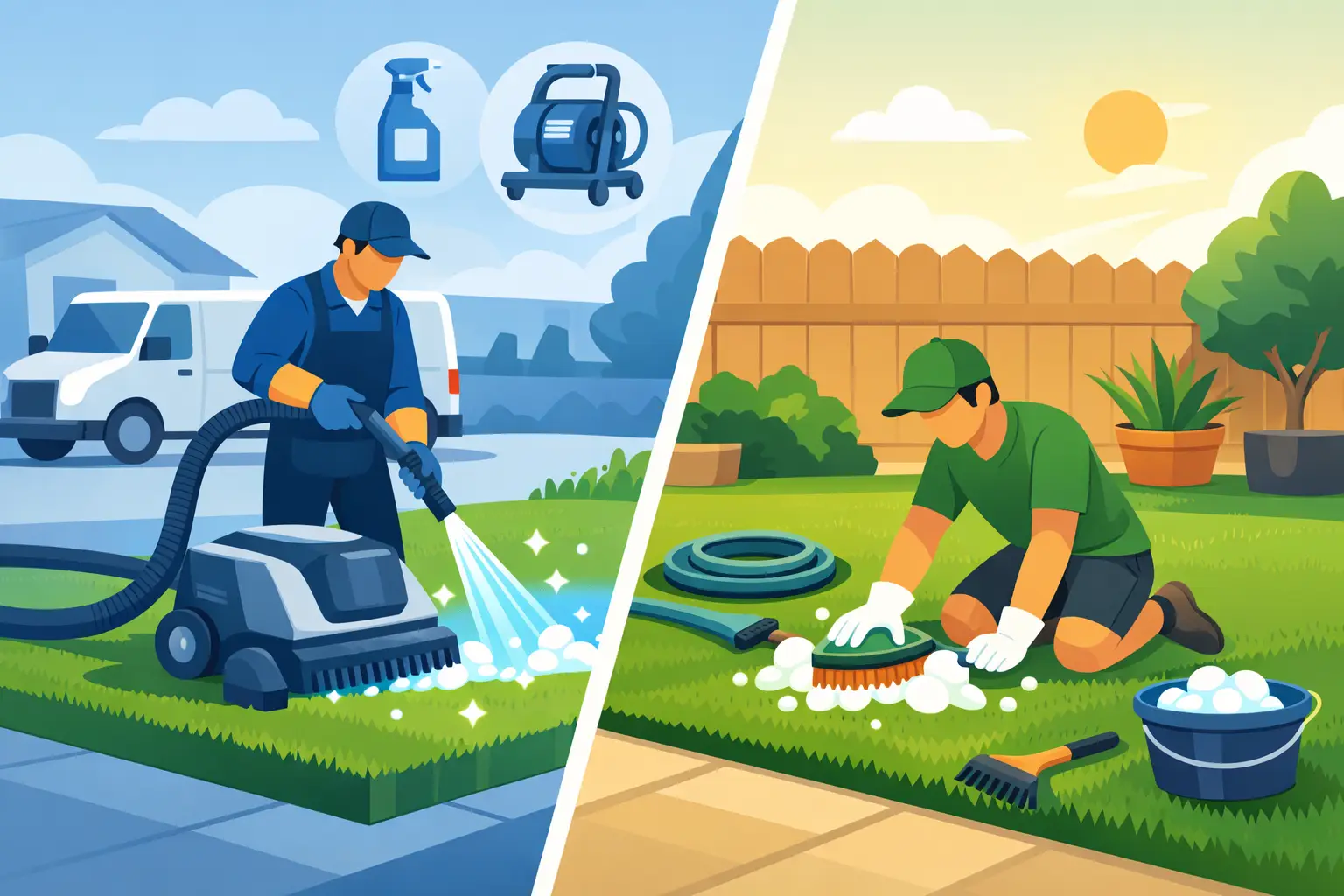
If your artificial grass still smells bad after you hose it down, you are already living the difference between professional turf cleaning vs DIY. A quick rinse can wash away surface dust. It does not pull out embedded pet urine, lift matted fibers, or knock back the bacteria causing that sour, stubborn odor that keeps coming back.
That is where a lot of homeowners get stuck. The turf looks worn. The pet area smells worse in the heat. Kids are still playing on it. And now the question is not whether to clean it, but whether you can fix it yourself or if it is time to bring in a turf specialist.
Professional turf cleaning vs DIY: what is the real difference?
The biggest difference is depth. DIY cleaning usually handles what is sitting on top of the turf. Professional service is built to treat what is buried in it.
Most homeowners do the right basic things. They rinse the turf, pick up pet waste, maybe spray a store-bought deodorizer, and brush the grass a little when it starts looking flat. That routine helps with appearance in the short term. It does not fully solve what happens below the surface when pet urine, hair, dust, and organic debris settle into the infill and backing over time.
Professional turf cleaning is a restoration process, not a cosmetic one. It typically includes power brushing to stand fibers back up, power sweeping to pull out trapped debris, deep rinsing to flush the turf, targeted odor and stain treatment, sanitizing, deodorizing, and in serious pet areas, urine extraction and post-treatment bacteria elimination. That is why the results feel different. The turf does not just look cleaner. It smells fresh, feels safer, and performs more like it should.
When DIY turf cleaning actually makes sense
DIY is not useless. It just has limits.
If your turf is fairly new, used lightly, and does not have a heavy pet load, basic maintenance can go a long way. A hose rinse can remove loose dust. A leaf blower or plastic rake can clear surface debris. A stiff turf-safe broom can help lift fibers in small sections. If you stay consistent, you can slow down buildup before it turns into a bigger problem.
For homeowners without pets, or with one dog and a well-managed cleanup routine, DIY may be enough for regular upkeep between deeper cleanings. The key is to be realistic. Routine maintenance is not the same thing as deep cleaning.
DIY also makes sense when the issue is mostly visual. Maybe the turf looks a little dusty after a dry stretch. Maybe leaves and hair are collecting along the edges. That is a maintenance problem, not necessarily a restoration problem.
Where DIY starts to fail
The trouble usually shows up in three ways: odor, flattening, and recurring grime.
Pet urine is the biggest reason homeowners give up on store-bought sprays and weekend rinses. Urine does not just sit on the blades. It works down into the infill and backing. In Arizona heat, that odor gets stronger fast. You can mask it for a day or two. You usually cannot remove it completely without deeper treatment.
Flattened turf is another sign. Once fibers are packed down by foot traffic, patio furniture, and pets running the same path every day, hand brushing often is not enough. The grass starts looking tired, worn, and uneven. It can make the whole yard feel dirty even after you clean it.
Then there is the grime you cannot easily see. Dust, pet dander, loose hair, bacteria, and small organic particles build up over time. If they stay trapped in the turf, they affect drainage, odor, and sanitation. That is why some yards smell bad even when they do not look terrible from a distance.
The hidden cost of doing it yourself
DIY cleaning looks cheaper at first. Sometimes it is. But only if it works.
A lot of homeowners end up spending money on hoses, brushes, deodorizing products, enzyme sprays, and repeated treatments that never fully solve the issue. The turf may smell better for a weekend, then go right back to the same problem. At that point, the cost is not just the products. It is also your time, your frustration, and the fact that the problem keeps getting worse underneath.
There is also the risk of using the wrong method. Overwatering can push contamination deeper or create drainage issues in already impacted areas. Harsh chemicals can leave residue behind or damage parts of the turf system. Aggressive tools can tear fibers or wear down the surface. Artificial grass is durable, but it is not maintenance-free, and it is not something you want to experiment on when the real problem is already advanced.
What professional turf cleaning is designed to solve
Professional service is built for the problems that routine upkeep cannot reach.
That usually means embedded pet urine, persistent odors, bacteria buildup, compacted infill, trapped debris, and grass that has lost its shape. Instead of treating one symptom, a proper deep cleaning process addresses the whole turf system.
Power brushing lifts the blades and helps restore the look of the lawn. Power sweeping removes hair, dust, and buried debris that hand tools leave behind. Deep rinsing clears out contaminants more effectively than a surface spray. Odor treatment targets the source instead of covering it up. Sanitizer and deodorizer treatments help reset the turf so it smells clean and stays fresher longer.
In heavier-use pet areas, urine extraction can be the difference-maker. If the odor has been sitting in the turf for months or years, basic rinsing is usually not enough. Deep extraction and post-treatment bacteria elimination attack the source that homeowners cannot fully reach on their own.
That is why professional turf cleaning feels like a reset, not just a touch-up.
Professional turf cleaning vs DIY for pet owners
If you have multiple dogs, frequent backyard use, or a designated pet relief area, professional turf cleaning vs DIY is usually not a close call. Pet-heavy turf needs more than maintenance. It needs periodic restoration.
That does not mean you should do nothing between visits. Daily waste pickup and light rinsing still matter. But once odors start lingering, or the turf feels sticky, dingy, or matted, the job has moved beyond casual upkeep.
For families with kids and pets sharing the same yard, sanitation matters just as much as smell. Nobody wants to wonder what is sitting in the turf on a hot afternoon. A professional cleaning helps restore confidence in the space. It makes the yard more usable again.
How to decide which option is right for your yard
Start with the actual condition of the turf, not just the price of the service.
If your turf has no real odor, drains well, and only needs light freshening, DIY maintenance may be enough for now. Stay consistent and do not wait until the yard starts smelling rough.
If the smell returns right after cleaning, if the grass is badly flattened, if debris keeps surfacing, or if the pet area feels unsanitary no matter what you use, that is a strong sign you need professional help. The longer those issues sit, the harder they are to correct with simple tools.
A good rule is this: if the problem lives below the surface, the solution needs to go below the surface too.
Why homeowners choose restoration over replacement
A lot of people assume old-looking turf needs to be replaced. Often, it needs to be restored.
That matters because artificial grass is a major investment. Before you spend thousands on tearing it out, it makes sense to see what a specialized deep cleaning can bring back. In many cases, the issue is not that the turf is finished. It is that it is overloaded with dirt, urine, bacteria, and wear.
That is exactly why services like Elite Turf Cleaning exist. The goal is not to make turf look a little better for a few days. The goal is to bring it back to life.
If your yard still looks flat, smells bad, or feels gross after your best DIY effort, that is your answer. Keep the basic upkeep for maintenance. Bring in professional cleaning when you need real restoration, real sanitation, and a yard you actually want to use again.
Your turf should not be the part of your home you avoid. It should feel clean, fresh, and ready for bare feet, pets, and everyday life.